
Search Escambia County Probate Court Records
Escambia County probate court records cover estate proceedings, wills, guardianships, and trust cases filed with the Clerk of Courts in Pensacola, the county seat of Florida's westernmost county. This page explains how to find those records, what types of probate exist, and where to get help navigating the process.
Escambia County Quick Facts
Escambia County Clerk of Courts
The Escambia County Clerk of Courts handles all probate case filings in the county. The main office is in downtown Pensacola and is open to the public on weekdays. Probate case files, once opened, become public records. Anyone can request access to them through the clerk's office.
The clerk receives petitions, letters testamentary, inventories, final accountings, and other documents filed during the probate process. The clerk does not give legal advice. Questions about how to complete forms or what to file should go to a licensed Florida attorney or a legal aid organization.
| Clerk of Court | Escambia County Clerk of Courts |
|---|---|
| Address | 190 West Government Street, Pensacola, FL 32502 (Mailing: P.O. Box 333, Pensacola, FL 32591-0333) |
| Phone | (850) 595-4310 | Alt: (850) 595-4360 |
| Website | escambiaclerk.com |
| Hours | Monday - Friday, 8:00 AM to 5:00 PM |
The Escambia County Clerk website provides access to online case searches, e-filing services, and fee schedules. The portal lets you search by party name, case number, or date range. It is a good first step before making a trip to the courthouse.
The Escambia County Clerk of Courts homepage is shown below. You can use it to start a records search or find contact information for the probate division.
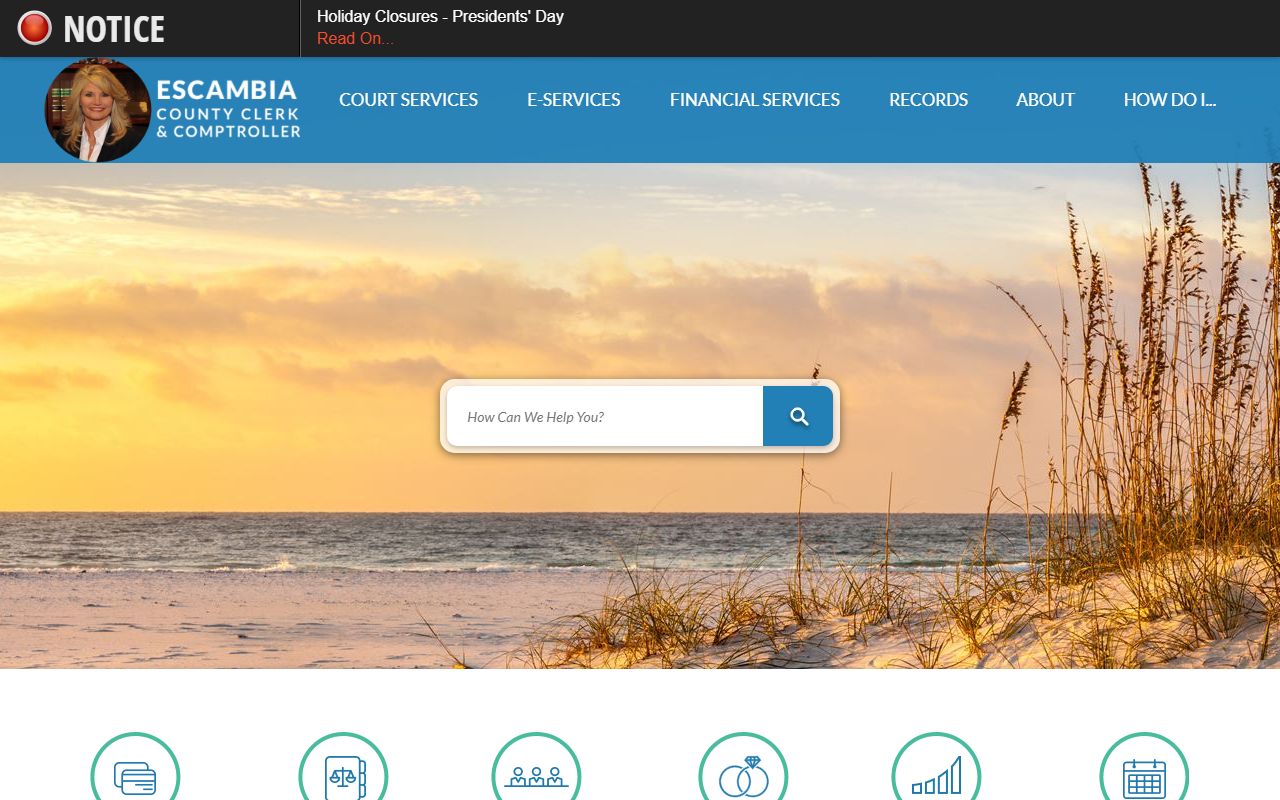
The online portal shown above is the fastest way to check whether a probate case was opened for a specific person in Escambia County. Results show the case number, filing date, and current status.
How to Search Probate Records in Escambia County
You have several options for finding probate records. Online search is fastest. In-person access gives you the most detail. Mail requests are possible but take more time.
Start at escambiaclerk.com. The public case search lets you look up probate cases by name or case number. You can see filing dates, case types, and whether the case is active or closed. This is free and does not require any registration.
The Florida Clerks of Court statewide directory is a useful tool if you need to confirm clerk contact details or find clerks in other counties. It is updated regularly by the Florida Association of Court Clerks and Comptrollers.

The statewide clerk directory shown above covers all 67 Florida counties. If your search extends beyond Escambia County, this is where to find the right clerk's office quickly.
For certified copies of probate documents, you must contact the clerk's office directly. Fees apply. Call (850) 595-4310 to confirm current copy fees and any ID requirements before you visit. Certified copies are typically needed for transferring property titles or dealing with financial institutions after a person dies.
In-person access at 190 West Government Street is the best option when you need to review a complete case file. The clerk's staff can pull the file for you to review at a public terminal in the courthouse. You can take notes or pay for copies while there.
Types of Probate Proceedings in Escambia County
Florida law provides three forms of probate administration. The right one depends mainly on the size of the estate and how much time has passed since the person died. Escambia County Circuit Court handles all three types.
Formal Administration
Formal administration applies when the estate's non-exempt assets exceed $75,000. This is the full probate process under Florida Statutes Chapter 733. The court appoints a personal representative who manages the estate, notifies creditors, and distributes assets to beneficiaries. The whole process can take six months to a year or more. A Florida-licensed attorney must represent the personal representative throughout.
Every step in formal administration generates court filings. The petition to open the estate, the inventory, the final accounting, and the order of discharge are all part of the public record kept by the Escambia County Clerk. Anyone can request access to these documents.
Summary Administration
Summary administration is a shorter process available under Florida Statutes Chapter 735. It applies when non-exempt assets are $75,000 or less, or when the decedent died more than two years ago. No personal representative is appointed. Beneficiaries petition the court directly, and the court issues an order of summary administration directing who receives what. This is faster and cheaper than formal administration.
Summary administration is popular in Escambia County for smaller estates where the decedent had a clear will and few creditor claims. The records are public and are kept with the clerk just like formal estate cases.
Disposition Without Administration
This is the simplest option under Florida law. It is available when there is no real property and the estate consists only of exempt assets or personal property that does not exceed the costs of the last illness and funeral expenses. The cap on non-exempt personal property is generally around $6,000. A surviving family member files a petition with the clerk, and in most cases no hearing is needed. This process is also governed by Chapter 735.
The 1st Judicial Circuit
Escambia County is part of Florida's 1st Judicial Circuit. The circuit also includes Okaloosa, Santa Rosa, and Walton counties. Judges assigned to the probate division hear all estate, guardianship, and trust matters for Escambia County. The 1st Judicial Circuit Court website lists judges by division and provides information on local court procedures and administrative orders.
Local administrative orders from the 1st Circuit can affect filing requirements and deadlines. Always check current local rules before submitting probate paperwork. The clerk's office at (850) 595-4310 can tell you what forms are currently required and whether any recent orders affect your case.
The Florida Courts statewide website has probate forms approved for use across Florida. Many standard forms are free to download. Self-represented parties handling simple estates sometimes use these forms with guidance from the Florida Courts self-help resources.
Legal Help for Escambia County Probate Cases
Pensacola has several legal resources available if you need help with a probate case. Legal Services of North Florida serves low-income residents in Escambia County and may help with basic probate questions. The Florida Bar Lawyer Referral Service connects you with local probate attorneys for an initial consultation, often at a reduced rate.
The Florida Courts self-help information page offers general guidance on probate procedures and links to standard forms. It is not a substitute for legal advice, but it can help you understand what to expect before you speak with an attorney or visit the clerk's office.
For the legal text governing probate in Florida, Chapter 733 covers formal administration and Chapter 735 covers summary administration and disposition without administration. Both are available online at no cost through the Florida Legislature's official website.
If you need to locate probate records in another Florida county, the Florida Clerks directory links to all 67 county clerk offices with current contact information.
Cities in Escambia County
Pensacola is the county seat and largest city in Escambia County, with a population of around 55,000. Other communities in the county include Ferry Pass, Brent, Ensley, and Bellview, which are unincorporated census-designated places. None of these communities exceed the 100,000 population threshold for a dedicated city records page on this site.
All probate cases for residents of Pensacola and throughout Escambia County are filed with the same clerk's office at 190 West Government Street. There is no separate courthouse for different cities within the county.
Nearby Counties
Escambia County shares borders with Santa Rosa County to the east and with the state of Alabama to the north. If an estate includes property in more than one county, ancillary filings may be needed with each county's clerk of courts.