
St. Johns County Probate Court Records
St. Johns County probate court records are filed with the Clerk of Circuit Court in St. Augustine and cover all estates, wills, and guardianship matters handled under Florida's Probate Code. The 7th Judicial Circuit oversees probate cases in St. Johns County, along with Flagler, Putnam, and Volusia counties. If you need to find an open estate, confirm whether a will has been deposited with the court, or get copies of probate filings, the St. Johns County Clerk of Court is the right place to start. The clerk's office handles public record requests, case lookups, and certified copy orders.
St. Johns County Quick Facts
St. Johns County Probate Court
The Clerk of Circuit Court for St. Johns County is Brandon Patty. The clerk's office handles all probate filings at the courthouse complex on Lewis Speedway in St. Augustine. The probate division operates as part of the Circuit Court, which has jurisdiction over estates, wills, trusts, and guardianships under Florida law.
| Clerk of Court | Brandon Patty |
|---|---|
| Address | 4010 Lewis Speedway, St. Augustine, FL 32084 |
| Phone | (904) 819-3600 |
| Website | stjohnsclerk.com |
| Hours | Monday - Friday, 8:00 AM to 5:00 PM |
The clerk's office at Lewis Speedway is the main filing location for all probate cases in St. Johns County. The address on Lewis Speedway is separate from the historic downtown courthouse. If you are visiting in person, confirm which location handles probate records before you go, as the clerk maintains multiple service points.
The 7th Circuit Court also serves Flagler, Putnam, and Volusia counties. Each county has its own clerk's office and file its own probate cases independently. If a decedent owned real property in more than one county within the 7th Circuit, separate filings may be required in each county.
The Florida Courts statewide directory can help you confirm St. Johns County clerk contact details and links to local court resources. The Florida Courts Find a Clerk page lists contact information for every county clerk in Florida.

Use this statewide directory to quickly verify clerk office details for St. Johns County and neighboring counties.
How to Search Probate Records in St. Johns County
The St. Johns County Clerk provides online case lookup through the stjohnsclerk.com website. You can search court records by party name, case number, or filing date. Probate cases appear under the civil court category. The online search is free and does not require registration.
Online results typically show the case number, decedent name, personal representative, date filed, and current status. You may be able to view some docket entries and document images. However, not every document in a probate file is posted online. Confidential records such as inventories and accountings are restricted under Florida law and are not available through public web portals.
To get full copies of a probate file, you can visit the clerk's office on Lewis Speedway during business hours. Bring the case number if you have it, or provide the decedent's full name and approximate year of death so staff can locate the file. Non-certified copies are available on the spot for a per-page fee. Certified copies take a bit more time to process.
Mail requests are accepted for copy orders. Send a written request to the probate division at 4010 Lewis Speedway, St. Augustine, FL 32084. Include the decedent's name, case number if known, and a check or money order for the estimated copy cost. The clerk's office can give you a cost estimate over the phone at (904) 819-3600 before you send payment.
You can also find the St. Johns County Clerk's online portal through the stjohnsclerk.com website, which lists all available record search options and services.
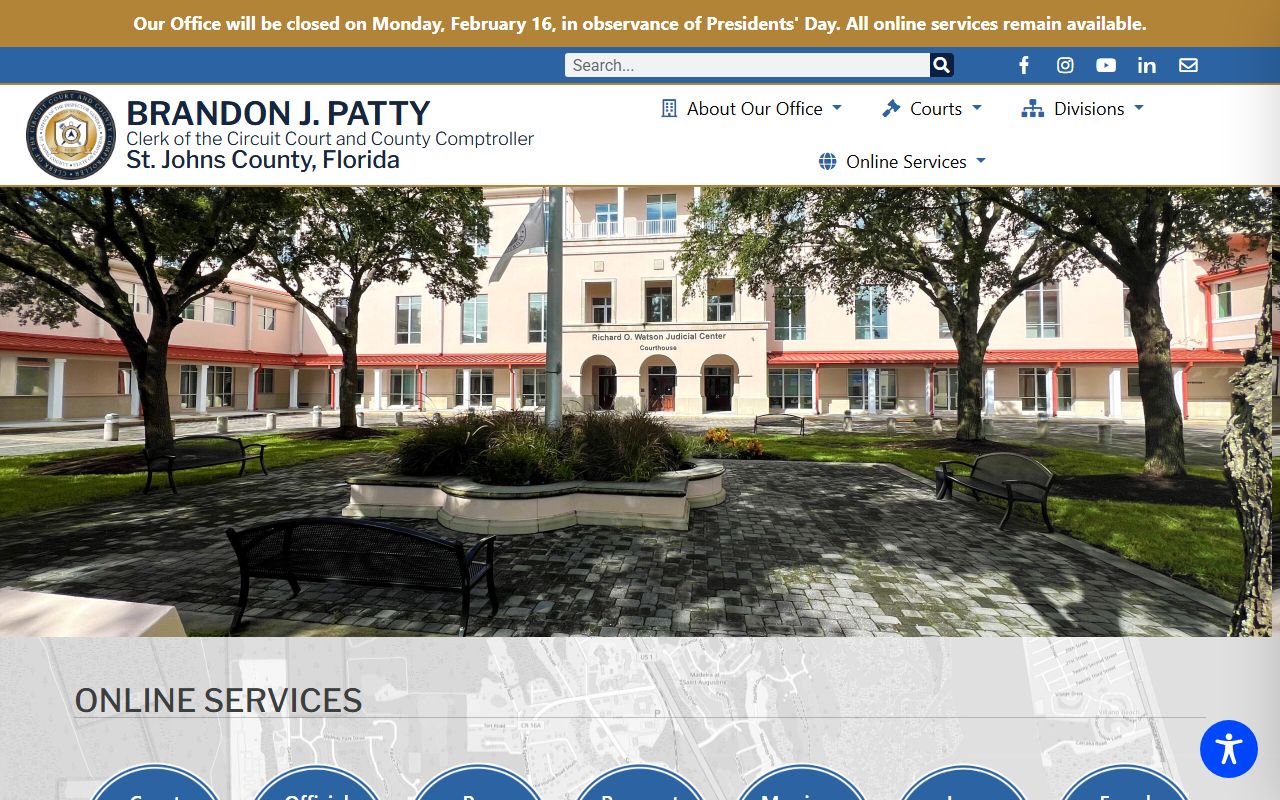
The clerk's website is the starting point for online searches, form downloads, and e-filing instructions for St. Johns County probate cases.
Types of Probate Cases Filed in St. Johns County
Florida law provides four types of probate proceedings. The right one depends on estate size, asset types, and how long the person has been deceased.
Formal Administration is the standard probate process for estates worth more than $75,000 or those that require a court-appointed personal representative. The court supervises asset collection, creditor notification, and distribution. An attorney is required unless the personal representative is also the only beneficiary. Formal administration cases in St. Johns County typically take six months to a year to close, and sometimes longer if there are disputes or complicated assets.
Summary Administration is for smaller estates. It applies when the total probate estate value is $75,000 or less, or when the decedent died more than two years ago. There is no personal representative appointment. Beneficiaries file a petition and, if approved, the court issues an order directing asset holders to release property. This process is faster and cheaper than formal administration.
Disposition Without Administration is the simplest path. It covers situations where the only assets are exempt personal property or property worth $6,000 or less needed to pay funeral and medical bills. No formal probate case is opened. An affidavit is filed with the clerk instead.
Ancillary Administration handles out-of-state decedents who owned Florida property. If someone died in another state but had real estate or financial accounts in St. Johns County, an ancillary probate case must be filed here to transfer those assets. The primary probate proceedings take place in the decedent's home state.
Filing Fees and Copy Costs
St. Johns County follows the Florida statutory fee schedule for probate filings. The exact fee depends on the estimated value of the estate and the type of proceeding. The clerk's office can tell you the exact fee when you call or visit, or you can check the fee schedule posted on the stjohnsclerk.com website.
For formal administration, filing fees are typically a few hundred dollars and rise with estate value. Summary administration fees are lower, generally in the range of $100 to $300 depending on the estate size. Disposition without administration carries a minimal filing fee.
Certified copies of probate documents cost approximately $2 per page plus a $1 certification fee. Non-certified copies are cheaper. You will need certified copies of Letters of Administration to open estate bank accounts, transfer real property, or deal with financial institutions. Keep extra certified copies on hand, as each institution typically keeps the copy you give them.
Publication of the creditor notice in a local newspaper is required for formal administration and is an additional cost. The clerk's office can direct you to approved newspapers for legal notice publication in St. Johns County. Newspaper publication fees vary and are paid directly to the publication.
If the estate cannot afford filing fees, a fee waiver request can be submitted with your petition. The court will review the estate's financial situation and decide whether to waive or reduce fees.
The Probate Process in St. Johns County
The probate process begins when the petitioner files the required documents with the St. Johns County Clerk. For formal administration, this includes the original will, a verified petition for administration, and the death certificate. The clerk assigns a case number and the file goes to a 7th Circuit probate judge.
The judge reviews the petition and, if everything is in order, issues an order admitting the will to probate and appointing a personal representative. The court then issues Letters of Administration, which give the personal representative authority to act on behalf of the estate. Banks, title companies, and other institutions require these letters before releasing assets.
The personal representative must send a Notice of Administration to interested parties, giving them time to object to the will or raise other issues. A Notice to Creditors must also be published in a local newspaper, starting a 90-day window for creditors to file claims. After the creditor period closes, the personal representative pays valid claims, handles taxes, and prepares to distribute the remaining assets.
Before closing the estate, the personal representative files an accounting with the court. Once the court approves the accounting and distribution plan, assets go to the beneficiaries and the personal representative files for discharge. The estate is then closed. The entire process for a straightforward formal administration in St. Johns County typically runs six months to one year.
Under Florida law, any person who holds a decedent's will must deposit it with the clerk within 10 days of learning of the death. This is required by Florida Statutes section 732.901, even if no probate case will be opened immediately.
Legal Resources and Self-Help
The Florida Bar's Find A Lawyer service at floridabar.org/public/directory can help you locate a probate attorney serving St. Johns County. Many attorneys offer free initial consultations, and some specialize in summary administration or simple estate matters.
Legal aid in St. Johns County is available through Jacksonville Area Legal Aid, which serves the 4th and 7th Circuits. Their website at jaxlegalaid.org lists eligibility requirements and services. Qualifying low-income residents may be able to get free help with basic probate matters.
The Florida Courts self-help center at selfhelp.flcourts.org provides forms, guides, and instruction packets for common probate proceedings. These are general resources and do not substitute for legal advice, but they can help you understand what documents you need and how the process works.
Florida's Probate Code is available at the Florida Legislature's website at leg.state.fl.us. Chapters 731 through 735 contain all the rules for probate administration, rights of creditors, and distribution of estates in Florida.
Cities in St. Johns County
St. Johns County includes St. Augustine, Ponte Vedra Beach, St. Augustine Beach, and other communities. None of these cities meet the population threshold for a dedicated city page on this site. All probate filings for residents of any St. Johns County city are handled by the Clerk of Circuit Court at 4010 Lewis Speedway in St. Augustine.