
Gulf County Probate Court Records
Gulf County probate court records are filed and maintained by the Clerk of Court in Port St. Joe, serving estates, guardianships, and trust matters under Florida's 14th Judicial Circuit. This page explains how to search those records, what types of probate cases exist, and what you need to file or request documents from the clerk's office.
Gulf County Quick Facts
Gulf County Clerk of Court
Tonya A. Knox serves as Clerk of Court for Gulf County. The clerk's office handles all probate filings, issues letters of administration, and maintains the official record of every estate case opened in the county. If you need certified copies of probate documents, you must go through this office.
| Clerk of Court | Tonya A. Knox |
|---|---|
| Address | 1000 Cecil G. Costin, Sr. Blvd., Room 149, Port St. Joe, FL 32456 |
| Phone | (850) 229-6112 | Alt: (850) 639-5068 |
| Website | Florida Clerks Directory |
| Hours | Monday - Friday, 8:00 AM to 5:00 PM |
The 14th Judicial Circuit covers Bay, Calhoun, Gulf, Holmes, Jackson, and Washington counties. The circuit court website at jud14.flcourts.org has additional procedural info, local rules, and judge assignments for probate divisions in all six counties.
The Florida Clerks directory at flclerks.com can also help you locate contact details and confirm the current clerk for Gulf County.
The 14th Circuit court portal gives researchers access to local standing orders and any administrative orders that affect probate procedure in Gulf County. It is worth checking before you file.
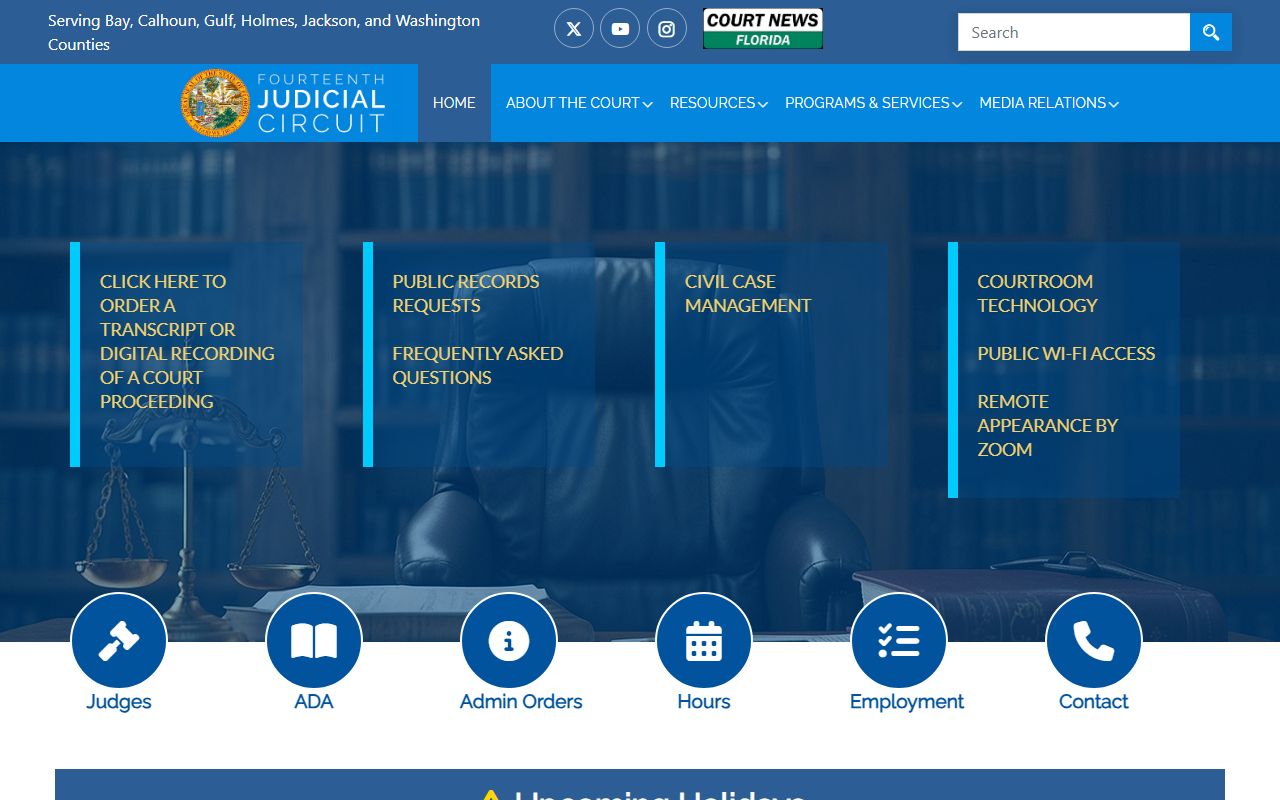
The 14th Circuit site above shows the portal used by attorneys and self-represented parties filing probate cases in Gulf County.

The Florida Court Clerks and Comptrollers directory helps you confirm clerk contact details for Gulf County and every other Florida county.
How to Search Gulf County Probate Records
Most Gulf County probate case records are public under Florida law. Here are the main ways to access them.
In person: Visit the clerk's office at Room 149, 1000 Cecil G. Costin, Sr. Blvd., Port St. Joe. Bring the decedent's full name and approximate date of death. Staff can pull case files and print copies for a per-page fee. Certified copies cost more than plain copies, so know what you need before you go.
By phone: Call (850) 229-6112 to ask about a specific case or confirm whether a probate was opened. Staff can often tell you the case number, case status, and whether letters were issued. They cannot give legal advice.
Online: Gulf County is a small county and may have limited online case search. Check the Florida Courts website for any statewide search tools. The Florida Courts eCaseView system covers some counties; availability changes as more clerks join.
Mail requests: Send a written request to the clerk's address with the case name or number, your contact info, and a check or money order for the fee. Call ahead to confirm the current copy fee schedule.
Florida Statutes Chapter 733 governs the probate code, and Chapter 735 covers disposition without administration and summary administration. Both are key for understanding which type of case may have been filed.
Types of Probate in Gulf County
Florida uses three main probate tracks. The value and nature of the estate usually determines which track applies.
Formal Administration
Formal administration is used when the gross estate exceeds $75,000, not counting exempt property. This is the full probate process. It requires a personal representative, a court-appointed attorney in most cases, notice to creditors, an inventory, and a final accounting before the court closes the estate. Cases can take six months to two years or more. Under Chapter 733, the personal representative must act as a fiduciary and follow strict deadlines set by the court and statute.
Summary Administration
Summary administration applies when the estate's exempt property plus non-exempt assets do not exceed $75,000, or when the decedent has been dead for two or more years. It is faster and cheaper than formal administration. No personal representative is appointed. Instead, the court issues an order of summary administration that distributes assets directly to beneficiaries. Chapter 735 governs this process. Petitioners must still give notice to known creditors.
Disposition Without Administration
This is the simplest track. It applies when the only assets are exempt property or non-exempt personal property with a value of $6,000 or less, and there is no real property. No personal representative is needed. The clerk can process this without a judge in some cases. It is mainly used to reimburse a person who paid the decedent's final expenses.
What Gulf County Probate Records Contain
Probate files in Gulf County can include a wide range of documents. Most are public record, though some parts may be sealed by the court.
Common documents in a probate file include the petition to open the estate, the original will (if one exists), an inventory of assets, creditor claims, accountings, and the final order closing the estate. If a guardianship is involved, the file will also include the guardian's annual reports and any court orders about the ward's care.
Letters of administration or letters of guardianship are official court documents that give the personal representative or guardian legal authority to act. Banks and financial institutions require these letters before releasing assets or account information.
All filed documents become part of the public court record unless a judge orders them sealed. This means anyone can request to see the file. However, certain sensitive documents, like medical records submitted in a guardianship case, may be protected.
Legal Resources and Self-Help
Gulf County is small and may not have a local legal aid office with a probate division. But there are still resources available.
The Florida Courts Self-Help Center has forms and guides for probate, including instructions for summary administration and disposition without administration. These are free to use.
The Florida Bar Lawyer Referral Service can connect you with a probate attorney licensed in Florida. For complex estates or contested matters, hiring an attorney is strongly advised. Gulf County's circuit covers a wide area, and a local attorney familiar with the 14th Circuit's local rules and judges can be valuable.
For estates with debts, tax issues, or disputes among heirs, formal administration in court with legal counsel protects everyone involved. Small estates often seem simple but can get complicated fast, especially when real property is involved.
Key Florida Probate Statutes
Two main chapters of Florida law govern probate in Gulf County. Chapter 733 is the Florida Probate Code. It sets out the rules for formal administration: who can be a personal representative, how creditors are notified, how assets are distributed, and when the estate can close. Chapter 735 covers the two simplified tracks: summary administration and disposition without administration. Knowing which chapter applies to your situation tells you what forms to file and what the court will expect from you during the process.
Cities in Gulf County
Gulf County has no cities that meet the population threshold for a dedicated city page. The main communities in the county are Port St. Joe (the county seat), Wewahitchka, and Port St. Joe Beach. Probate cases for all of these communities are filed at the Gulf County Clerk of Court in Port St. Joe.
Nearby Counties
If the estate involves property in a neighboring county, you may need to file ancillary probate there as well. The counties that border Gulf County are listed below.