
Highlands County Probate Court Records
Highlands County probate court records are filed with the Clerk of Court in Sebring, handling all estate cases, wills, and guardianship matters under Florida's 10th Judicial Circuit. This page covers how to search those records, what the three probate tracks require, where to get legal help, and what a Highlands County probate file typically contains.
Highlands County Quick Facts
Highlands County Clerk of Court
The Highlands County Clerk of Court is located in Sebring, the county seat. The clerk's office handles all probate petitions and court filings, maintains the complete case docket, and issues official documents like letters of administration. Any request for probate documents in Highlands County goes through this office.
| Clerk of Court | Highlands County Clerk of Court |
|---|---|
| Address | 590 South Commerce Avenue, Sebring, FL 33870-3867 |
| Phone | (863) 402-6565 |
| Website | Florida Clerks Directory |
| Hours | Monday - Friday, 8:00 AM to 5:00 PM |
Highlands County is in the 10th Judicial Circuit with Hardee and Polk counties. The circuit court at jud10.flcourts.org has local probate rules, judge assignments, and standing orders that govern how cases are handled in Sebring. Review local rules before you file, since some 10th Circuit requirements go beyond the statewide Florida Probate Rules.
The Florida Clerks statewide directory verifies contact information for the Highlands County clerk and can help if you need to work with clerks in Polk or Hardee for multi-county estate matters.
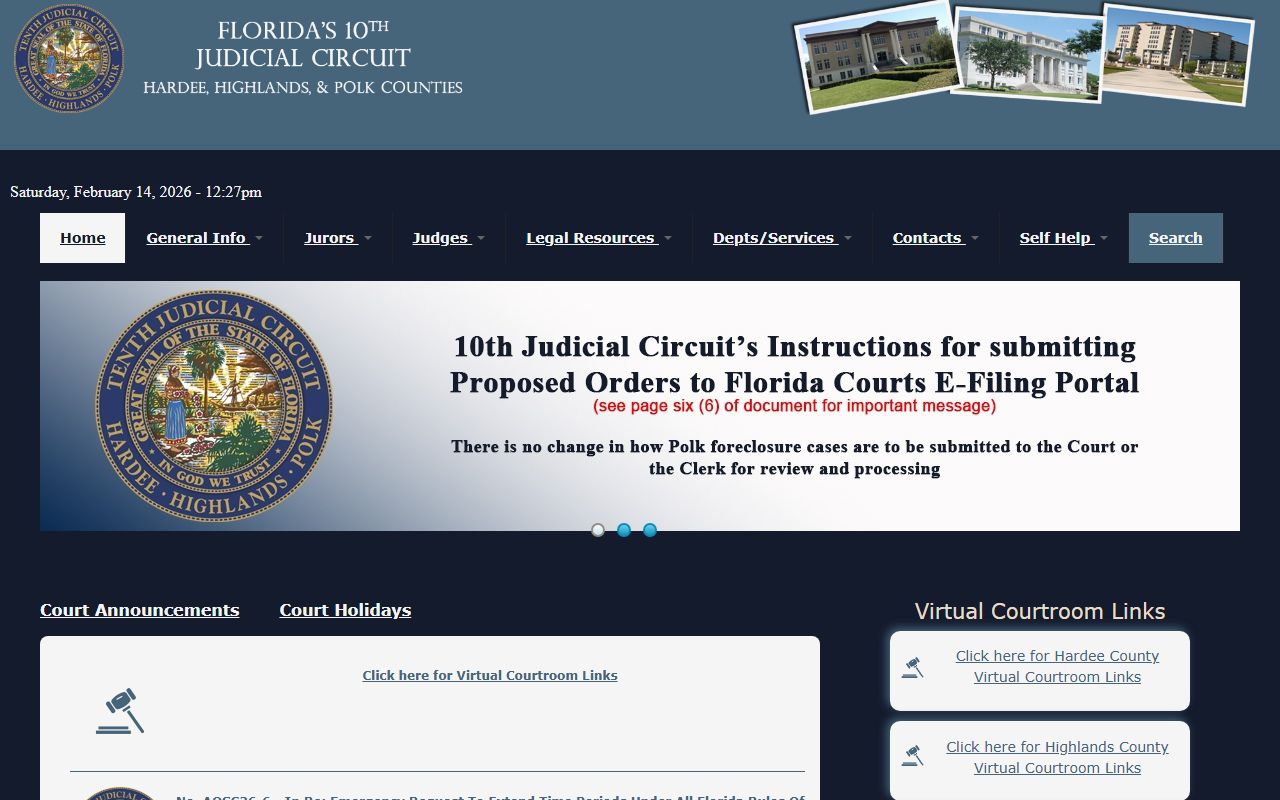
The 10th Circuit site above is where you find the local rules and judge information for probate cases filed in Sebring at the Highlands County courthouse.
The Florida Clerks statewide directory gives you direct contact information for Highlands County and all 67 Florida county clerks.
How to Search Highlands County Probate Records
Probate records in Highlands County are public under Florida law. You can access them several ways.
In person: Visit the clerk's office at 590 South Commerce Avenue, Sebring. Bring the decedent's full name and the approximate date of death. Clerks can search by name or case number and produce the file for you to review. Copy fees are charged per page. Ask about the fee schedule when you call or arrive.
By phone: Call (863) 402-6565 to check on a specific case or ask whether probate was ever filed. Staff can give you basic case information and the case number. They will not give legal advice. If you have a billing question about copy fees, this is also the right number to call.
Online: Check the 10th Circuit site and the Florida Courts website for available online search tools. Polk County, which shares the 10th Circuit, has more online access than Highlands County, but statewide eCaseView access continues to expand. It is worth checking the clerk's own website or calling to ask what is available digitally before making the drive to Sebring.
Mail: Write to the clerk at 590 South Commerce Avenue, Sebring, FL 33870-3867. Include the decedent's name, case number if you have it, your return address, and a check or money order for estimated copy fees. Call ahead to get the current fee so your request is not delayed.
Florida Chapter 733 controls formal administration and Chapter 735 controls summary administration and disposition without administration. Knowing which applies tells you what to expect in the case file.
Types of Probate in Highlands County
Florida law provides three paths for handling a decedent's estate. The right one depends on the value of the estate and how long the decedent has been dead.
Formal Administration
Formal administration applies when the gross non-exempt estate exceeds $75,000. This is the full probate process under Chapter 733. The court appoints a personal representative who must inventory all assets, publish a notice to creditors in a local newspaper, give written notice to known creditors, wait out the creditor claim period of 90 days from first publication, resolve all claims, file a final accounting, and get a court order closing the estate. The entire process takes a minimum of six months. Complex estates can take much longer, especially when heirs dispute the will, creditor claims are large, or the estate includes real property in multiple counties.
Summary Administration
Summary administration is available when the total non-exempt estate assets are $75,000 or less, or the decedent has been dead for two or more years. Under Chapter 735, no personal representative is appointed. The beneficiaries file a petition and the court enters a single order distributing assets. This is faster and less expensive than formal administration. Known creditors must receive notice before the court enters the order, and any creditor can object and request a hearing.
Disposition Without Administration
This is the simplest track. It applies when the decedent left no real estate and the only non-exempt assets are personal property worth $6,000 or less. No personal representative is needed. The main purpose is reimbursing whoever paid the decedent's final medical bills or funeral expenses. In some cases the clerk can process this without a judge's hearing. It is fast, cheap, and limited to the very specific facts the statute describes.
What Highlands County Probate Records Contain
Probate files in Highlands County are court records and are generally open to the public. Here is what a typical estate file holds.
The first document is the petition to open probate. It names the decedent, lists heirs or beneficiaries, states the approximate estate value, and identifies the type of proceeding requested. If a will was left, the original is attached and filed with the court. After a hearing or by written order, the court admits the will to probate and it becomes a permanent public record. Anyone can get a copy of a probated will.
As the estate progresses, the file adds an inventory of assets with values, a list of all creditor claims filed, responses to those claims, any court orders resolving disputes, the personal representative's accountings, and eventually the final order closing the estate and discharging the personal representative. Every one of these documents is public unless a judge orders specific items sealed.
Letters of administration are formal court documents that authorize the personal representative to act. Banks, brokerages, and other financial institutions require certified copies of these before releasing any estate assets. Highlands County charges a per-page fee for certified copies. Ask the clerk about the current fee schedule.
Legal Help and Self-Help Resources
Highlands County has an older-than-average population, and probate matters are common. Several resources exist for residents who need help navigating the process.
The Florida Courts Self-Help Center provides free forms and written guides for summary administration and disposition without administration. These are the same forms used in Highlands County. The guides walk you through each step and tell you what to file and in what order.
For formal administration, contested estates, or guardianship cases, working with a licensed Florida probate attorney is the right approach. The Florida Bar can provide referrals. Sebring has local attorneys, and Polk County (Lakeland and Bartow) is close enough that many attorneys practice in the 10th Circuit across all three counties. Look for someone with experience in the Sebring courthouse and Highlands County's specific probate division.
Senior legal aid services are also worth checking. Organizations that serve Highlands County residents may provide free consultations for probate matters involving smaller estates, especially for elderly or low-income residents. The 10th Circuit court website may list some of these resources.
Key Florida Probate Statutes
Two chapters of Florida law control every probate case filed in Highlands County. Chapter 733 is the Florida Probate Code. It covers every step of formal administration: who may serve as personal representative, how the estate inventory works, how creditors must be notified and paid, and when the court can enter a final discharge. Chapter 735 handles the simplified procedures, summary administration and disposition without administration. These two chapters together tell you what the Highlands County court expects at every stage of the probate process, regardless of which track applies to your situation.
Cities in Highlands County
Highlands County has no cities that meet the population threshold for a dedicated city page. The main communities are Sebring (the county seat), Avon Park, Lake Placid, and Frostproof. All probate court filings for Highlands County are handled at the Clerk of Court at 590 South Commerce Avenue in Sebring.
Nearby Counties
Highlands County sits in the center of the state and borders several counties. If an estate has property in more than one county, ancillary probate filings may be needed in neighboring courts.