
Access Okeechobee County Probate Court Records
Okeechobee County probate court records are maintained by the Clerk of Courts and cover formal estate administrations, summary administration petitions, will deposits, guardianship cases, and related civil matters for residents of this rural south-central Florida county. The 19th Judicial Circuit covers Indian River, Martin, Okeechobee, and St. Lucie counties, and Okeechobee County probate cases fall under that circuit's jurisdiction. This page explains how to search probate records, which process fits your estate, and how to get in touch with the clerk or find legal help in the area.
Okeechobee County Quick Facts
Okeechobee County Clerk of Courts - Probate Division
The Okeechobee County Clerk of Courts handles all probate filings for the county. The courthouse is located on NW 3rd Street in Okeechobee city. Given the county's small size, the clerk's office is accessible for most residents. Call ahead to confirm hours and what you will need to bring before visiting.
| Clerk of Court | Okeechobee County Clerk of Courts |
|---|---|
| Address | 312 NW 3rd Street, Okeechobee, FL 34972 |
| Phone | (863) 763-2131 |
| Hours | Monday - Friday, 8:00 AM to 5:00 PM |
Most probate documents are public records. However, inventories and accountings filed in estates are confidential under Florida law. Florida law also prohibits the Clerk from placing an image or copy of a court file on a publicly available Internet Web site. Some documents can only be accessed by visiting the clerk's office or submitting a formal written copy request.
The Florida Courts website provides statewide guidance on probate processes, approved forms, and links to all county clerks. It is a good resource for understanding what filings are needed and how the process works before you contact the clerk's office directly.
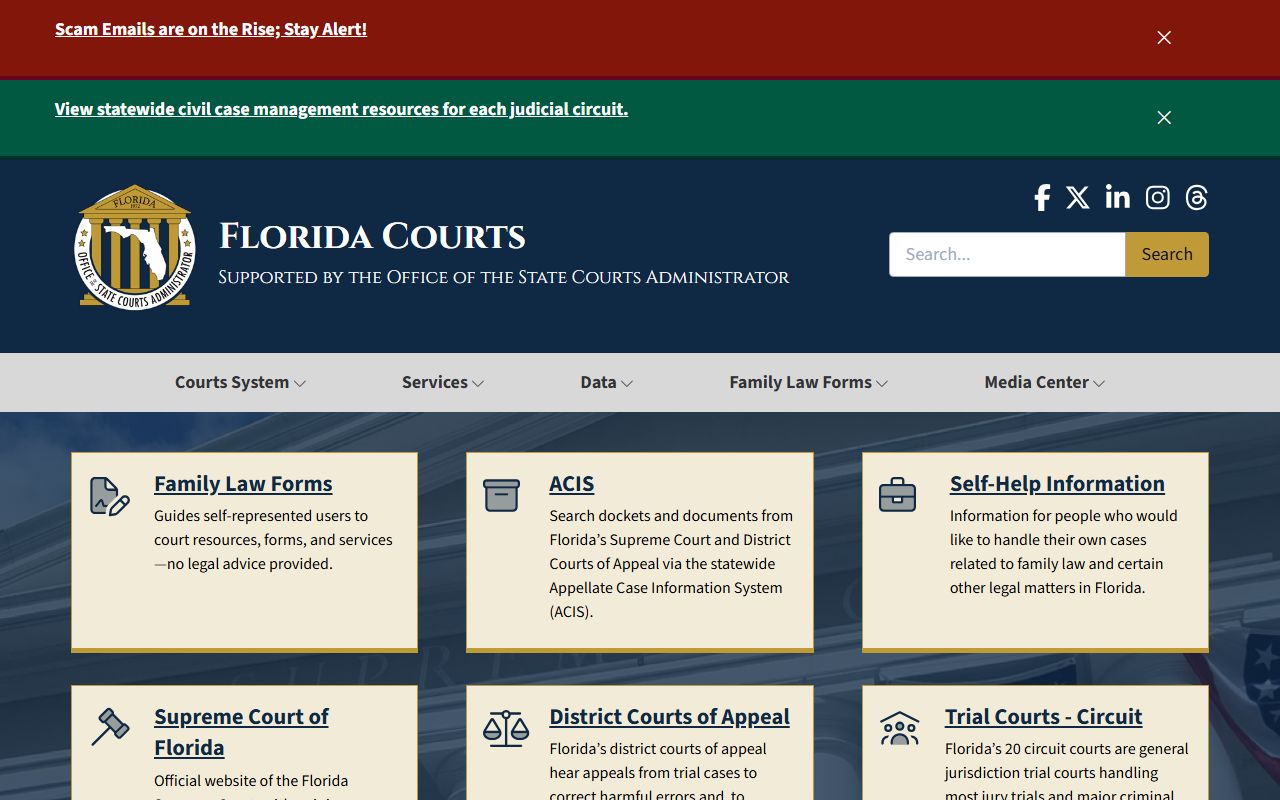
The Florida Courts site at flcourts.gov has approved probate forms that are accepted in Okeechobee County and every other Florida county, along with guides on how to use them.
19th Judicial Circuit
The 19th Judicial Circuit covers Indian River, Martin, Okeechobee, and St. Lucie counties along Florida's Treasure Coast and inland areas. Okeechobee County probate cases are heard under this circuit's jurisdiction. The 19th Circuit website at jud19.flcourts.org has information on judge assignments, local administrative orders, and procedural guidelines for probate matters in all four counties.
Circuit-level administrative orders apply to all counties in the 19th Circuit. These orders may specify how petitions must be formatted, what documents must accompany a filing, and how hearings are scheduled. Check the 19th Circuit site before filing to see if any current local orders affect your case.
Okeechobee County is the smallest county in the 19th Circuit by population. Cases tend to be fewer in number, but the same statewide rules and circuit procedures apply. The county's rural character means many estates involve agricultural land, cattle, and other farm assets in addition to or instead of residential real estate.
How to Search Okeechobee County Probate Records
The Okeechobee County Clerk of Courts provides case search access for public probate records. You can search by the decedent's name or a case number if you have one. Public case information includes filing dates, party names, docket entries, and hearing dates. Because Florida law restricts the online posting of court file images, detailed document access may require an in-person visit or a formal copy request.
To request copies, contact the clerk's office at (863) 763-2131. Staff can confirm whether a specific record is available and what the copy fee will be. Certified copies of letters of administration or court orders are often needed by banks, title companies, or other parties who need proof of the estate's status.
If you are not sure which county holds the probate records you need, the Florida Association of Court Clerks and Comptrollers maintains a statewide Find-a-Clerk directory listing contact information for all 67 Florida county clerks.

The Find-a-Clerk tool at flclerks.com/page/findaclerk makes it simple to locate the right clerk's office when a decedent owned property in more than one county or when you are unsure where the estate was filed.
Types of Probate in Okeechobee County
Florida law provides three different probate processes. Which one applies to a given estate depends on the estate's gross value and how long ago the decedent died. All three types of cases are filed with the Okeechobee County Clerk of Courts.
Formal Administration
Formal administration is required when the estate's gross value is more than $75,000 and the decedent died less than two years ago. The circuit court appoints a personal representative, creditors are formally notified and given time to file claims, an inventory of assets must be filed, and a final accounting is submitted before the court closes the estate. An attorney is generally required for formal administration under Florida law. The process can take six months to two years or longer depending on the size and complexity of the estate and whether any disputes arise among heirs or with creditors.
Summary Administration
Summary administration is available when the estate's gross value is $75,000 or less, or when the person has been dead for two or more years. No personal representative is appointed. Interested parties file a petition listing the assets and proposed distribution, and the court issues an order directing how the assets are to be distributed. This is a shorter and less expensive process than formal administration. In Okeechobee County, the two-year rule is a common basis for summary administration when families wait before dealing with an estate.
Disposition Without Administration
When an estate has only personal property worth $6,000 or less and no real estate, a family member can seek a disposition without administration. This is the simplest path and does not require a full court case. The clerk's office has the required form. It is most often used to collect a small bank account or transfer a vehicle title after someone dies with minimal assets.
The governing statute for all three processes is Florida Statutes Chapter 733, which sets out the full framework for estate administration in Florida, including the duties of personal representatives, creditor claim procedures, and rules for distribution of estate assets.
Special Considerations for Okeechobee County Estates
Okeechobee County has a large agricultural base. Estates in this county often include farmland, ranch property, cattle, and farm equipment in addition to or instead of typical residential assets. Agricultural land can be tricky to value for probate purposes, and its classification may affect estate taxes and transfer procedures. An appraiser familiar with agricultural property in south Florida can help establish a fair market value for probate purposes.
Some agricultural land in Okeechobee County may be held under a life estate deed or in a trust, which can affect whether it goes through probate at all. If the decedent set up a revocable living trust, property in that trust generally does not go through probate. Talk to a probate attorney about how the decedent's property was titled before assuming that all assets need to go through the court process.
Okeechobee County is also a rural area with limited access to some legal services. Remote options such as phone consultations and email are often available from attorneys in larger nearby counties. The Florida Bar Lawyer Referral Service can help connect you with attorneys who handle rural Okeechobee County matters.
Filing Fees and Legal Resources
Okeechobee County follows the statewide probate filing fee schedule set by Florida law. Fees for formal administration are based on the estate's estimated gross value. Summary administration petitions carry a separate flat fee. Certified copies of court orders cost additional amounts per page. Call the clerk's office at (863) 763-2131 to confirm current fees before filing.
The Florida Courts website at flcourts.gov offers free approved probate forms accepted statewide. Legal Services of the Treasure Coast may offer free civil legal help to qualifying low-income residents in Okeechobee County. Contact their intake line to find out if your situation qualifies. The Florida Bar Lawyer Referral Service can also connect you with a local probate attorney if paid representation is needed.
Cities in Okeechobee County
Okeechobee County has one incorporated city, the City of Okeechobee, which serves as the county seat. With a population of roughly 6,000, the city does not meet the threshold for a dedicated city page on this site. All probate filings for county residents are handled by the Clerk of Courts at 312 NW 3rd Street in Okeechobee.
Nearby Counties
Okeechobee County is bordered by Glades County to the west, Highlands County to the north, Osceola County to the northwest, Indian River County to the east, St. Lucie County to the southeast, Martin County to the south, Palm Beach County to the south, and Osceola County to the northwest. Each neighboring county has its own clerk of courts and probate division.