
Search Clearwater Probate Court Records
Clearwater is the county seat of Pinellas County, which means the probate courthouse is right here in the city. All probate cases for Clearwater residents are filed with the Pinellas County Clerk of the Circuit Court and heard by judges in the 6th Judicial Circuit. This page covers how to search those records, what types of cases exist, what fees apply, and where to get help if you need it.
Clearwater Quick Facts
Pinellas County Handles Clearwater Probate
Because Clearwater is the county seat, the Pinellas County Clerk of the Circuit Court sits right downtown at 315 Court St. Residents do not have to travel to another city to file or pick up records. The clerk's office handles all probate filings for Clearwater and the rest of Pinellas County under the 6th Judicial Circuit, which covers both Pinellas and Pasco counties.
| Clerk of Court | Ken Burke |
|---|---|
| Address | 315 Court St, Clearwater, FL 33756 |
| Phone | (727) 464-7000 |
| Website | www.pinellasclerk.org |
| Hours | Monday - Friday, 8:00 AM to 5:00 PM |
See the full Pinellas County probate records page for more on the county system, branch offices, and local rules that govern all Pinellas probate cases.
The 6th Circuit probate division handles estates, guardianships, and will deposits for all of Pinellas County. Judges rotate through the probate division on a regular schedule. When you file, your case is assigned to a division and a judge. The clerk's office can tell you which division your case is in and when hearings are scheduled.
The Pinellas County Clerk site is shown below. It has links to online case search, forms, and fee schedules.
Pinellas County Clerk of the Circuit Court official website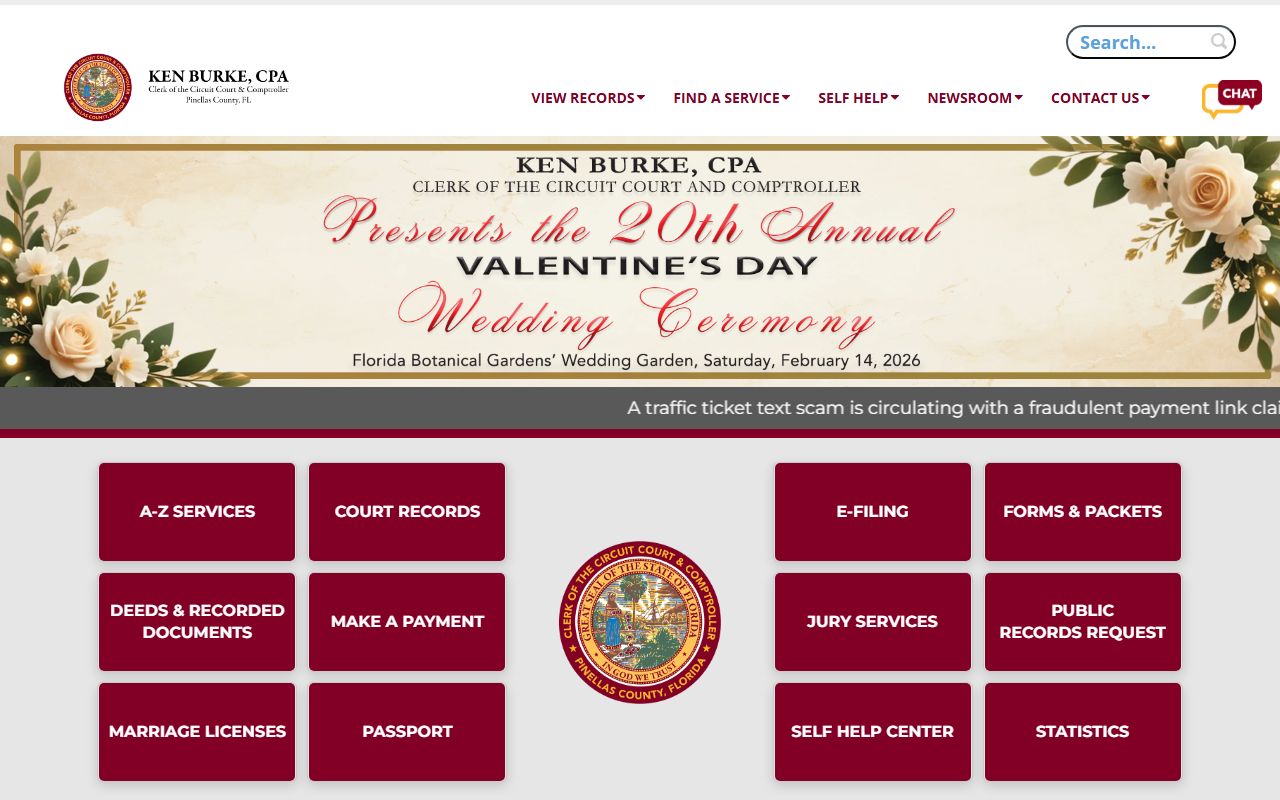
The clerk site lets you search probate cases by name or case number, view filing dates, and request copies of documents for Clearwater and all other Pinellas County estates.
How to Search Clearwater Probate Records
The Pinellas County Clerk offers online case search through their website at pinellasclerk.org. You can search by name, case number, or a combination. The search is free and does not require a login. Most active and recently closed probate cases appear in the system.
Search results show the case type, the parties involved, filing dates, and the status of the case. You can also see a list of documents filed, though some are restricted. Under Florida law, probate inventories and accountings are confidential records. The public can see that these documents exist and when they were filed, but not what is in them unless you have a legal standing to view them and make a specific request at the clerk's office.
To get copies of non-restricted documents, you can request them in person at 315 Court St, by mail, or by contacting the clerk's records department by phone. Bring the case number if you have it. If you only have a name and approximate date of death, the clerk's staff can search the system and help you identify the right case.
For older records that may not be in the online system, the clerk's office maintains paper and microfilm files. Some historical probate records from the late 1800s and early 1900s may be held in the Pinellas County archives. Call ahead if you are researching a very old estate to confirm availability and location.
In-person visits are the most reliable way to get full access. The courthouse is centrally located in downtown Clearwater, making it convenient for most residents of the city to reach without a long drive.
Types of Probate Cases in Clearwater
Florida law provides several paths for settling an estate. Which one applies to a Clearwater resident's estate depends mainly on the value of assets left behind and how long ago the person died.
Formal Administration is the standard full probate process. It is required when the estate has more than $75,000 in non-exempt assets. The court appoints a personal representative, who then gathers assets, notifies creditors, pays debts, files an inventory and accountings, and ultimately distributes what remains to heirs. The whole process typically runs from six months to well over a year. Florida law requires an attorney to handle formal administration in most cases.
Summary Administration is the shorter track. It is available when the total non-exempt assets are $75,000 or less, or when the deceased has been gone for more than two years. No personal representative is appointed. The petitioner asks the court to order distribution of the estate directly. Summary administration moves much faster than the formal process, often wrapping up in a few weeks to a few months. Many Clearwater families use this for modest estates, especially for surviving spouses.
Disposition Without Administration is the simplest option of all. It applies when the estate has no real property and the total value of assets does not exceed the amount needed to pay funeral costs and final medical bills. The clerk issues an authorization letter rather than a court order. No judge needs to sign off. This is often used when a small bank account is the only asset and a funeral home or hospital needs to be paid.
Wills must be filed with the clerk within 10 days of the testator's death under Florida Statute 732.901. This is a mandatory rule. Failing to deposit a will can create legal liability. Filing the will does not automatically open a probate case. It just places the document in the court's custody. Any interested party can petition to admit the will to probate later.
Guardianship cases are handled by the same division. If a Clearwater resident becomes incapacitated and cannot manage their finances or personal affairs, a guardian may be appointed through the probate court. Guardianship cases can involve significant ongoing court oversight and annual reporting requirements.
Fees for Pinellas County Probate Filings
Filing fees in Pinellas County follow the state schedule set by the Florida Legislature. The fee to open a probate case depends on the assessed value of the estate. For very small estates valued under $1,000, the filing fee is roughly $235. The fee increases with the estate value. The clerk's office at (727) 464-7000 can give you the exact amount for a specific estate before you file.
Certified copies cost $1.00 per page plus $2.00 per document for the certification seal. If you need the documents mailed to you, add a small fee for postage and handling. Exemplified copies, which carry both the court seal and the clerk's signature and are sometimes needed for out-of-state property transfers, cost a bit more.
There is no charge to search records online. Viewing case information through the Pinellas Clerk portal is free. Downloading or printing documents through the system may carry a per-page fee depending on the file type and current system settings.
If fees are a hardship, you can file an Application for Determination of Civil Indigent Status at the clerk's office. A judge reviews the application and may waive or defer fees for qualifying applicants. This process is separate from the main case and does not delay filing.
Attorney fees for probate in Florida are set by a fee schedule in Florida Statute 733.6171. The schedule is based on a percentage of the estate value. Attorneys may charge more with court approval for extraordinary services. You can negotiate fee arrangements, but the court has final say on what is reasonable in formal administration cases.
Legal Resources for Clearwater Residents
Clearwater and Pinellas County have solid options for people who need legal help with probate but cannot afford a private attorney. Bay Area Legal Services at bals.org provides free civil legal assistance to low-income residents across the Tampa Bay area, including Pinellas County. Probate and guardianship are among their service areas. Income limits apply, so call to confirm eligibility before your appointment.
The Pinellas County Bar Association runs a lawyer referral program. You can get a referral to a probate attorney who offers reduced-cost initial consultations. The Florida Bar's Find a Lawyer tool also lets you search by county and practice area. Filtering for Pinellas County and estate or probate law brings up licensed attorneys in the area.
The Florida Courts Self-Help Center at flcourts.gov has forms and guides approved by the Florida Supreme Court. These cover summary administration, disposition without administration, and other common probate scenarios. The forms are the same ones attorneys use. The guides explain how to fill them out and what to file where.
The Clearwater city website is shown below. While the city does not handle probate cases, it can help residents find local services and contact information for county offices.
City of Clearwater official website
The city site provides local government contacts and resources that can help Clearwater residents navigate county services, including the probate court located at 315 Court St downtown.
The Clearwater Probate Process
Probate in Clearwater starts with a petition filed at the Pinellas County Clerk's office at 315 Court St. In a formal administration, the court first determines whether a valid will exists and who should serve as personal representative. If there is a will, the court admits it to probate. If not, the court applies Florida's intestacy laws to determine who inherits.
Once the personal representative is appointed and letters of administration are issued, the real work begins. The personal representative must locate and value all estate assets, notify known creditors in writing, and publish a notice to creditors in a Pinellas County newspaper for two consecutive weeks. Creditors then have 90 days from the date of first publication to file their claims, or 30 days from when they received direct notice, whichever is later.
After the creditor period closes, the personal representative pays valid debts in the order of priority set by Florida law. Funeral costs and family allowances come first. Then come administrative costs, taxes, and other debts in the order the statute specifies. Whatever remains goes to the beneficiaries according to the will or the intestacy rules.
A final accounting is filed with the court. If no objections are raised, the judge enters a final order of discharge. The case closes. For summary administration, the timeline is much shorter because there is no personal representative and the court simply orders distribution without the full creditor notice process.
Ancillary probate is worth knowing about if you are dealing with an out-of-state estate that includes Clearwater property. If someone lived in another state but owned real estate in Clearwater or elsewhere in Pinellas County, their heirs must open an ancillary probate proceeding in Pinellas County to transfer or sell that property. The main estate can be handled in the home state, but the Florida property requires a Florida court order.
All of this is governed by Florida Statutes Chapters 731 through 735. These chapters set the rules for everything from who can serve as personal representative to how disputes are resolved and what happens when an estate is insolvent.