
Search Lakeland Probate Court Records
Probate cases for Lakeland residents are filed through Polk County, which is served by the 10th Judicial Circuit of Florida. Lakeland has its own branch courthouse at 930 E Parker Street, making it easier to access court services without driving to the county seat in Bartow. This page covers how to find probate records, what types of cases exist, how fees work, and what the process looks like for estates in Lakeland.
Lakeland Quick Facts
Polk County Handles Probate for Lakeland Residents
Florida law says probate must be filed in the county where the deceased person lived. For Lakeland residents, that is Polk County. The Polk County Clerk of Courts manages all probate case filings for the county. The 10th Judicial Circuit covers Polk, Hardee, and Highlands counties, but each county has its own clerk and clerk's office.
Lakeland is Polk County's largest city and has a branch courthouse at 930 E Parker Street. Some court functions are available there. However, certain probate filings and hearings may require a trip to the main Polk County Courthouse in Bartow at 255 N Broadway Avenue. It is worth calling the clerk's office in advance to confirm where to file specific documents.
| Clerk of Court | Stacy Butterfield |
|---|---|
| Lakeland Branch | 930 E Parker St, Lakeland, FL 33801 |
| Main Courthouse | 255 N Broadway Ave, Bartow, FL 33830 |
| Phone | (863) 534-4000 |
| Website | polkclerk.net |
| Hours | Monday - Friday, 8:00 AM to 5:00 PM |
See the Polk County probate records page for more detail on county-wide procedures and resources.
How to Search Lakeland Probate Records
The Polk County Clerk provides an online case search at polkclerk.net. You can search by the decedent's name, case number, or filing date. Most probate case filings are public record in Florida. Inventories and accountings are exceptions — those documents are confidential by law and not available to the public through online search or in-person requests.
Public documents you can typically access include the petition for administration, the will (if one was filed), letters of administration, notices to creditors, and final orders. Certified copies cost a per-page fee plus a certification fee per document. You can request copies in person at either the Lakeland branch or the Bartow main courthouse.
The 10th Judicial Circuit's website provides information on how probate cases are handled in Polk County, including judge assignments and hearing procedures.
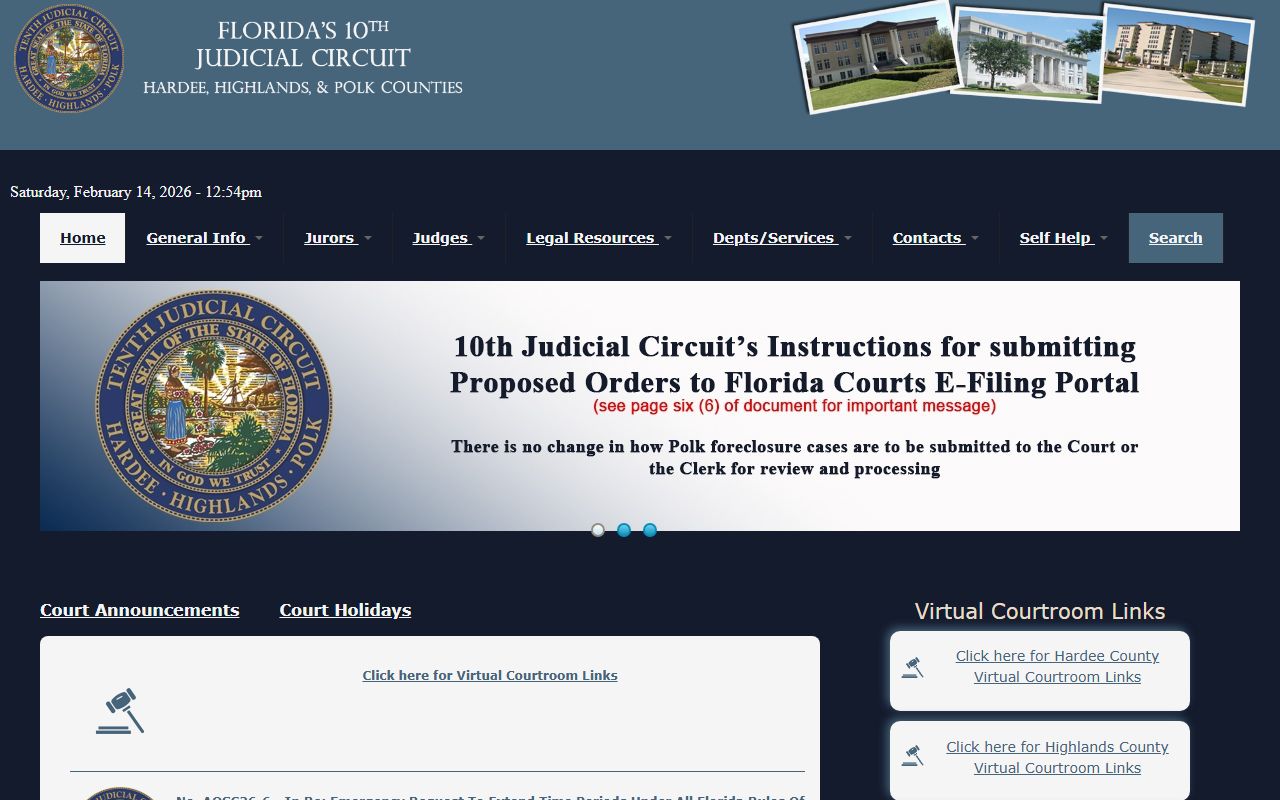
The 10th Circuit serves Polk, Hardee, and Highlands counties. Probate cases for Lakeland fall under Polk County within the 10th Circuit.
If you want to search in person, the Lakeland branch courthouse at 930 E Parker Street can help with many clerk functions. Calling ahead to confirm what services are available there before you visit is a good idea. The main courthouse in Bartow has the full probate division.
Types of Probate Cases in Polk County
Florida's probate code covers several ways to administer a deceased person's estate. All of these are filed through the Polk County Clerk. The right type depends on the estate's value and timing.
Formal Administration is required when the estate's non-exempt assets are worth more than $75,000. This is the full probate process and involves the most steps. The court appoints a personal representative. Creditors are notified by mail and through a published notice. An inventory of assets is filed. After the creditor period closes and valid claims are paid, the personal representative files a final accounting and seeks discharge from the court. Formal administration typically takes six months to a year.
Summary Administration is available for estates worth $75,000 or less in non-exempt assets, or for cases where the person has been dead for more than two years regardless of estate size. It is faster and simpler. The petitioner files a petition listing assets and proposed distribution. If the court approves, it issues an order directing how assets are paid out. No personal representative is appointed in most cases.
Disposition Without Administration is the simplest option and does not require a court hearing. It is only available when the estate has no real property, the only debts are funeral and medical expenses from the final illness, and total assets are under $6,000. The clerk's office handles this directly.
Under Florida Statute 732.901, any person who has custody of a will must file it with the clerk of the county where the decedent lived within 10 days of death. This is required even if no probate is planned. The filed will becomes part of the public record.
The Lakeland city government does not handle probate. All filings go to the Polk County Clerk.

City offices in Lakeland handle municipal services. Probate is a county court matter handled through the Polk County Clerk of Courts.
Probate Filing Fees in Polk County
Polk County follows Florida's statewide fee schedule for probate filings. Fees are set by the state legislature. Here is what to expect when filing for a Lakeland estate.
Formal administration carries a filing fee of roughly $400 or more, depending on the size of the estate. Summary administration petitions are less expensive, typically in the $235 to $300 range. Both types of cases can have additional charges: certified copies cost per page, and notice to creditors must be published in a local newspaper (Bartow is typically used for Polk County notices, but some publications serve the Lakeland area).
Attorney fees in Florida probate are set by statute. They start at 3% of the first $1 million of the gross estate value. This is a statutory guideline, not a cap, and attorneys can petition for additional compensation in complex cases.
If the personal representative is required by the court to post a bond, the cost comes from estate funds and is paid to a surety company. The amount depends on the total estate value.
Always confirm current fees with the Polk County Clerk before filing. The fee schedule is posted on the clerk's website at polkclerk.net.
Legal Resources for Lakeland Residents
If you need legal help with a probate matter in Lakeland, several resources are available. The Polk County Bar Association can help connect you with a local probate attorney. Their referral service is a good starting point for finding someone with experience in Polk County estates.
Community Legal Services of Mid-Florida serves Polk County and provides free legal help to income-eligible residents. Probate assistance may be available depending on the case and current caseloads. Their contact information is available at clsmf.org.
The 10th Circuit maintains a self-help center at the courthouse that provides procedural guidance. Staff can explain forms and processes, though they cannot give legal advice. For straightforward summary administrations, some people manage the process on their own using the self-help center's resources.
The Florida Bar's lawyer search tool at floridabar.org lets you find licensed probate attorneys in Polk County. You can filter by city and practice area.
Florida's full probate code is in Chapters 731 through 735 of the Florida Statutes. These are free to read online at leg.state.fl.us. Understanding the basics before you meet with an attorney or file anything can save time and money.
The Probate Process for Lakeland Estates
When a Lakeland resident dies with assets that need to pass through probate, the process starts at the Polk County Clerk's office. Whether you file at the Lakeland branch or the Bartow main courthouse depends on the specific filing and the clerk's current procedures. Call ahead to confirm.
For formal administration, someone files a petition for administration along with the will and death certificate. The court appoints a personal representative, who receives letters of administration. Those letters are the legal proof needed to access bank accounts, sell property, and handle other estate matters.
The personal representative notifies creditors by mail and by publishing a notice in a newspaper. Creditors have 90 days from the first publication to file claims. After the creditor period ends, the personal representative pays valid claims, files a final accounting with the court, and then petitions for discharge. The court reviews and closes the estate.
Summary administration moves faster. The petitioner files a single petition listing assets and who should receive them. If the court approves, an order issues quickly. There is no creditor waiting period in the same form as formal administration, though creditor rights are still protected.
Lakeland's size and Polk County's relatively straightforward court system mean probate cases here tend to move at a normal pace. Hiring an attorney, at least for an initial consultation, is a smart step for most families. Simple cases can sometimes be handled without legal help, especially for summary administration of small estates.