
Jacksonville Probate Court Records
Probate records for Jacksonville residents are filed and maintained by the Duval County Clerk of Court, which serves as the official recordkeeper for all estate proceedings in the consolidated City of Jacksonville. Because Jacksonville and Duval County merged governments in 1968, there is one unified clerk's office handling all probate matters for the area. Whether you need to search an open estate, locate a deposited will, or request copies of probate filings, the Duval County Clerk is your starting point. This guide covers how to find records, what types of cases exist, and what to expect during the process.
Jacksonville Quick Facts
Which County Handles Probate for Jacksonville
All probate cases for Jacksonville residents are handled by the Duval County Clerk of Court. Florida law requires that a probate case be filed in the county where the deceased person was domiciled at the time of death. Since Jacksonville is coextensive with Duval County, that means all estate matters go through one office. The clerk's probate division processes formal administrations, summary administrations, and disposition without administration filings. Ancillary cases for out-of-state decedents who owned property in Jacksonville also come through this office.
| Clerk of Court | Jody Phillips |
|---|---|
| Address | Duval County Courthouse, 501 W Adams St, Jacksonville, FL 32202 |
| Phone | (904) 255-2000 |
| Website | duvalclerk.com |
| Hours | Monday - Friday, 8:00 AM to 5:00 PM |
The Duval County Clerk handles all civil filings, including probate. The probate division is part of the civil courts section. If you call the main line, ask specifically for the probate division. Staff can confirm whether a case exists, give you a case number, and explain how to get copies. They do not give legal advice, so for specific questions about your estate situation, you need an attorney.
The 4th Judicial Circuit also covers Clay and Nassau counties. If a decedent lived just outside Jacksonville in Orange Park (Clay County) or Fernandina Beach (Nassau County), the probate case would be filed in those respective county clerks' offices, not Duval's.
View all Duval County probate records information
The Duval County Clerk's website provides an overview of probate services and case search tools.
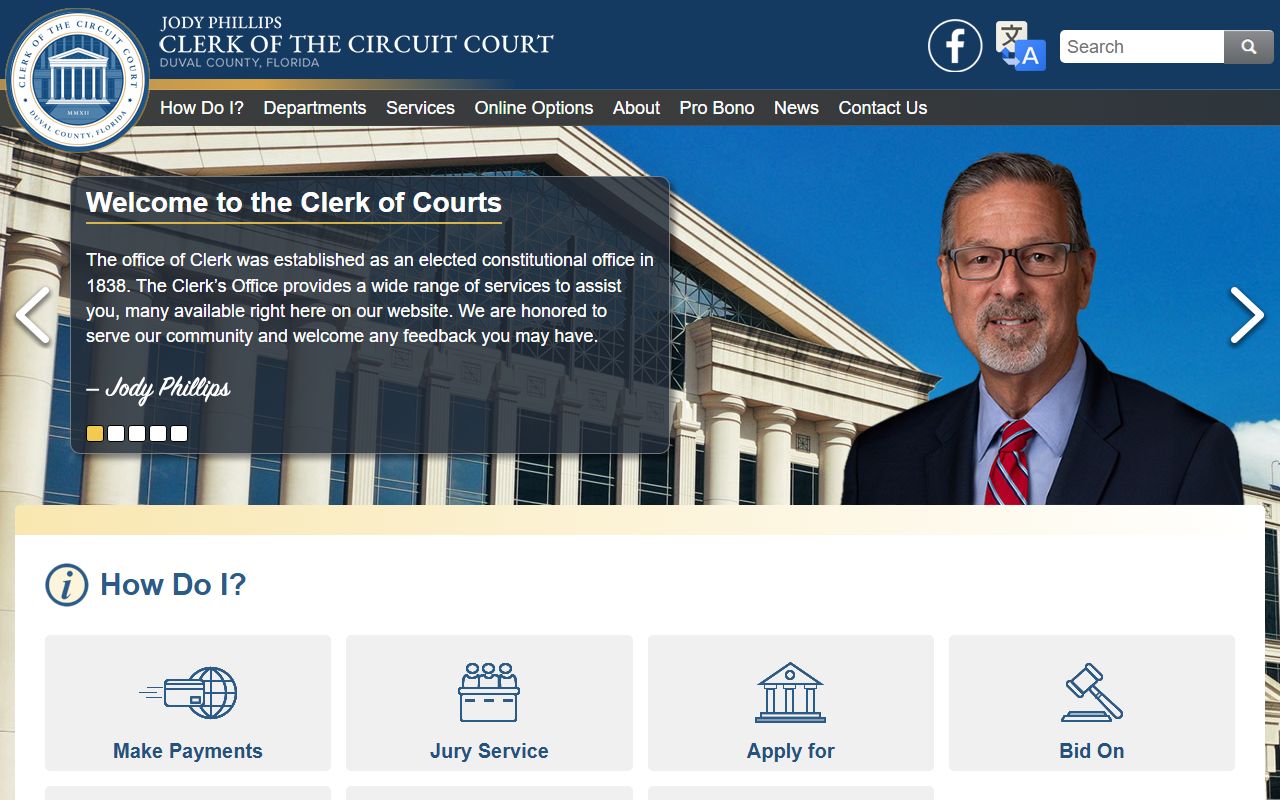
From the clerk's homepage you can access online case search, request certified copies, and find forms for various probate proceedings.
How to Search Probate Records for Jacksonville Residents
The Duval County Clerk provides online case search through its public portal at duvalclerk.com. You can search by party name, case number, or attorney of record. Results show case type, filing date, parties involved, and a list of documents on file. Most documents in a probate case are public record. However, inventories and accountings filed after January 1, 2002 are confidential under Florida law and are not available in the public search portal.
To search online, go to the clerk's site and click the case search or official records link. Enter the decedent's last name and first name. The system may return multiple results if the name is common, so check the date of death or case number to confirm you have the right case.
If you need to search in person, go to the courthouse at 501 W Adams St. Public terminals are available in the clerk's office. Staff can assist with basic searches. In-person searches are free. Certified copies cost $1.00 per page plus a $2.00 certification fee. Uncertified copies are typically $1.00 per page. Bring the case number if you have it, as it speeds up the process.
Mail requests are accepted. Write to the Duval County Clerk, Civil Division, 501 W Adams St, Jacksonville, FL 32202. Include the decedent's full name, date of death if known, and a check or money order for copy fees. The clerk's office will search the records and send copies by return mail. Response times vary, but budget one to two weeks.
Wills that were deposited with the clerk but have not yet been probated are also on file. Under Florida Statute 732.901, anyone who has custody of a will must file it with the clerk of the county where the decedent lived within 10 days of learning of the death. These deposited wills are public record and can be viewed or copied.
Types of Probate Cases in Jacksonville
Florida recognizes several types of probate proceedings, and the right one depends on the size and complexity of the estate. The four main types you will see in Duval County court records are formal administration, summary administration, disposition without administration, and ancillary administration.
Formal Administration is the full probate process. It is required when the estate's value exceeds $75,000 (excluding exempt property) or when the decedent has been dead less than two years. An attorney must represent the personal representative unless the personal representative is the sole beneficiary. Formal administration involves court supervision, appointment of a personal representative, notice to creditors, an inventory, and a final accounting. These cases can take six months to two years to close, depending on complexity and whether there are disputes.
Summary Administration applies when the estate value is $75,000 or less, or when the decedent has been dead for more than two years. It is faster and less expensive. There is no personal representative appointed. Instead, beneficiaries petition the court directly. An attorney is still typically needed, but the process is simpler. Summary administration cases are common in Duval County for smaller estates.
Disposition Without Administration is the simplest option. It applies when the estate has no real property, no non-exempt personal property, and the only assets are needed to pay funeral expenses and final medical bills. No formal probate is opened. The clerk processes a simple petition and authorizes the transfer of specific funds.
Ancillary Administration is used when someone who lived outside Florida died with property in Jacksonville, such as a vacation home or investment property. A separate Florida probate proceeding opens here in Duval County to handle just the Florida assets, while the main estate is handled in the decedent's home state.
Filing Fees and Costs in Duval County
Filing a probate case in Jacksonville involves fees set by Florida law. These apply across the state, so Duval County uses the same schedule as other Florida counties.
For formal administration, the filing fee is based on the estimated estate value. Estates valued at $1,000 or less pay $235. Estates between $1,001 and $10,000 pay $300. Estates from $10,001 to $50,000 pay $400. Estates from $50,001 to $100,000 pay $900. Estates over $100,000 pay $900 plus $1.00 for each additional $1,000 of value above $100,000, up to a cap set by statute. Summary administration petitions have a lower fee, typically around $235 to $300 depending on estate value.
Beyond filing fees, expect costs for certified mail notice to creditors, publication fees for the Notice to Creditors in a local newspaper (required for formal administration), and attorney fees. Attorney fees in probate are either set by agreement or can follow Florida's statutory guidelines, which set a percentage of the estate value as a reasonable fee. For a $200,000 estate, the statutory attorney fee is around $5,500. Courts can approve higher fees for extraordinary services.
Copy fees are $1.00 per page for uncertified copies. Certified copies cost $1.00 per page plus a $2.00 certification fee per document. There is no fee to search the online case portal.
Local Legal Resources in Jacksonville
If you need help navigating the probate process in Jacksonville, several local resources are available. These can be useful whether you are a family member trying to understand what to do, or someone who cannot afford an attorney.
Jacksonville Area Legal Aid (JALA) provides free civil legal services to low-income residents. Probate matters may qualify for assistance depending on the circumstances. Contact JALA at (904) 356-8371 or visit jaxlegalaid.org to check eligibility and request services.
The Jacksonville Bar Association offers a lawyer referral service. Call (904) 399-5780. For a modest fee, you can get a 30-minute consultation with a probate attorney, which can help you understand your options before committing to full representation.
Florida Bar Lawyer Referral Service covers the whole state. Call 1-800-342-8011 or use the online portal at floridabar.org. You can search specifically for probate attorneys in Jacksonville or Duval County.
The Duval County Clerk's self-help resources page lists probate forms and basic instructions. These are helpful for understanding the process but do not substitute for legal advice. For any estate that goes to formal administration, retaining an attorney is strongly recommended and often required by Florida law.
The Probate Process for Jacksonville Residents
When someone who lived in Jacksonville dies, the probate process follows a set sequence. Understanding these steps helps you know what to expect and how long it might take.
First, locate the original will if one exists. Under Florida Statute 732.901, the person holding the will must deposit it with the Duval County Clerk within 10 days of learning of the death. Failure to do so can result in liability. Even if you do not plan to open probate right away, the will must be filed promptly.
Second, determine whether probate is needed. Not all assets go through probate. Assets with named beneficiaries (life insurance, retirement accounts, payable-on-death bank accounts) pass directly. Property held in joint tenancy passes by operation of law. Assets held in a living trust pass through the trust, not the court. Only assets titled in the decedent's name alone, without beneficiary designations, typically require probate.
Third, choose the right type of proceeding. If the estate qualifies for summary administration or disposition without administration, those are faster and cheaper. An attorney can help you determine which applies.
Fourth, file the petition with the Duval County Clerk at 501 W Adams St. The clerk assigns a case number. For formal administration, the court appoints the personal representative and issues Letters of Administration, which give the representative authority to act on behalf of the estate.
Fifth, notify creditors. In formal administration, a Notice to Creditors must be published in a local newspaper and served on known creditors. Creditors have 90 days from the date of first publication (or 30 days from service, whichever is later) to file claims against the estate.
Finally, after debts and taxes are paid, remaining assets are distributed to beneficiaries and the estate is closed. The court enters an order of discharge, and the probate case is complete.